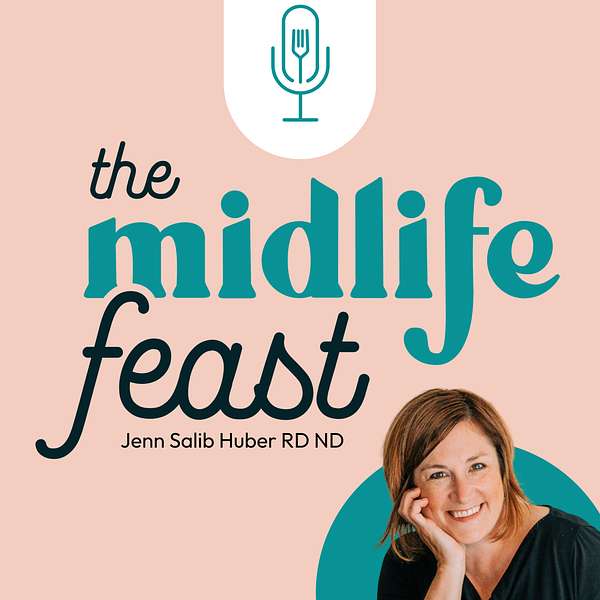
The Midlife Feast
Welcome to The Midlife Feast, the podcast for women who are hungry for more in this season of life. I’m your host, Jenn Salib Huber, dietitian, naturopathic doctor , intuitive eating counsellor and author of Eat to Thrive During Menopause. Each episode “brings to the table” a different perspective, conversation, or experience about life after 40, designed to help you find the "missing ingredient" you need to thrive, not just survive.
The Midlife Feast
#176: Anti-Diet Menopause in the Age of Ozempic With Dr. Mara Gordon
Welcome to 2026, where it suddenly feels harder than ever to talk about menopause, health, and nutrition without the conversation getting hijacked by weight loss. In this longer-than-usual episode, I’m joined by family physician and writer Dr. Mara Gordon (who proudly describes herself as an “anti-diet doctor”) to talk about the question that's been on my mind lately: Is a weight-neutral menopause still possible?
Mara and I unpack what weight neutrality actually means in real-world healthcare, why the “weight loss fixes everything” narrative has gotten louder again, and whether GLP-1 medications can fit into an informed, values-based, body-autonomy-first approach to care.
In this episode, we talk about:
- What I mean by “weight neutral” (and why it’s not the same as “anti-weight loss”)
- Why menopause weight changes can create so much urgency, fear, and pressure
- How to support weight-neutral conversations even when cholesterol, blood sugar, or blood pressure change
- The “Mediterranean pattern,” and why nutrition strategies can help without turning into restriction
- GLP-1s: what they can do well (and what they cannot do)
- Why a lot of expectations about weight loss are shaped by culture, not medicine
- Why “I want to avoid meds” is often about something deeper than the medication
About my guest, Dr. Mara Gordon
Dr. Mara Gordon is a family physician in Camden, New Jersey. She’s also a writer, including NPR’s Real Talk with a Doc column, and she writes a Substack newsletter called Your Doctor Friend, about healthcare being a mess and how we can figure it out together. She’s also working on a book about diet culture and medicine, expected in 2027.
Links & resources
- Dr. Mara Gordon’s Substack: Your Doctor Friend
- NPR column: Real Talk with a Doc
- My website + free resources + coaching: menopausenutritionist.ca
If this episode hit home
Share it with a friend who’s feeling the pressure to “fix” her midlife body. And if you have a question you want me to tackle on a future episode, send it my way.
Enjoying the show?
Follow The Midlife Feast and leave a review. It helps more midlife women find evidence-based, weight-neutral support that doens't feel like a diet.
What did you think of this episode? Click here and let me know!
📚 I wrote a book! Eat To Thrive During Menopause is out now! Order your copy today and start thriving in midlife.
Looking for more about midlife, menopause nutrition, and intuitive eating? Click here to grab one of my free guides and learn what I've got "on the menu" including my 1:1 and group programs. https://www.easy.link/menopause.nutritionist
Welcome to the Midlife Feast, the podcast that helps you make sense of your body, your health, and menopause in the messy middle of midlife. I'm Dr. Jen Selie Pieper, intuitive eating dietitian and naturopathic doctor, and author of Eat to Thrive During Menopause. Around here, we don't see midlife and menopause as problems to solve, but as invitations to live with more freedom, trust, and joy. Each week you'll hear real conversations and practical strategies to help you feel like yourself again, eat without guilt, and turn midlife from a season of survival into a season of thriving. I'm so glad you're here. Let's dig in. Hi there and welcome to 2026. So, for the last 10 years, I have been practicing as an intuitive eating dietitian and have, you know, very proudly and happily been practicing in this weight-inclusive health and every size space. And for the first five years of that practice, it really felt like the world was on board and the world of medicine was on board. And in the last few years, for reasons that I get into with my guests today, it feels like that weight neutral conversation is maybe getting quieter. And it's challenging to have a conversation in 2026 about menopause and health and nutrition that doesn't also talk about weight loss. So it was difficult to find a guest in many ways that I felt I could have a really good, meaningful conversation with, somebody who gets both sides, I guess you could say, of the story. But I am so happy that Dr. Mara Gordon accepted my invitation after I heard her on a couple of other podcasts to join me to have this conversation about how do we have a weight neutral menopause? Or is that even still possible? So we dive into a lot of things. This is a longer episode than usual, and it's because I felt like this topic deserved more than 30 minutes. So we talk about Dr. Gordon's experience with weight neutrality in her practice. We talk about why the weight conversation is front and center in menopause. And yes, we also talk about GLP1s. And so if you have questions about any of these things, I encourage you to get comfortable, make a cup of tea, and let me know what you think. Thanks to Dr. Gordon for taking the time and definitely check out her substack, especially. Really, I put all the links in the show notes, but I really appreciate the work that she's doing, and I especially appreciate her writing. So let's get on with this episode. Welcome, Dr. Gordon, to the podcast.
SPEAKER_01:Thank you so much. And please feel free to call me Mara. But it's such a pleasure to be here. Thanks. I'm a fan of your work, and I think we're gonna have a lot of really interesting stuff to discuss.
Jenn Salib Huber:Definitely some mutual admiration. Um, because we've already been talking for almost 20 minutes before we hit record. So I feel like this is gonna be a really great conversation. But before we dive into talking about weight neutrality in menopause and midlife and all the things that circle that discussion, I would love for you to just introduce yourself to my audience.
SPEAKER_01:Yeah, thanks. Thank you. So I'm Dr. Amara Gordon. I am a family physician in practice in Camden, New Jersey, which is a small city outside of Philadelphia. I live in, I live in and I call myself an anti-diet doctor. And I have landed on a definition over talking about this in many different ways in many different contexts, which is basically I don't yell at my patients to lose weight. And it's so simple and yet so complicated in healthcare, because I think to a lot of my colleagues, that can be a pretty controversial thing, and we can get more into that. Um and but I've I've landed on that because, you know, I I do have a lot of conversations with my patients about body size. Um, I have a very general practice, not focused on any one particular thing. I accept all insurance. Um I would say the majority of my patients are low income. So a lot of diversity in my practice and people coming from really different worldviews, different goals for their bodies. And so we do it all in primary care. And I'm also a writer. And I write NPR's Real Talk with a Doc column, which is a monthly column about health issues. If you ever have any questions, please contact me. We love uh reader and listener questions. And I write a Substack newsletter that's called Your Doctor Friend, just about healthcare being a mess and how we can figure it out together. Um, and I'm working on a book too about diet culture and medicine that, God willing, will be coming into the world in 2027.
Jenn Salib Huber:Oh my gosh. And it is so needed, so needed. So I'm very excited for that book. And it's interesting because I I love that you mentioned that, you know, you don't yell at your patients that that's or about weight loss, that that's your definitely try to. I first heard you say that on Virginia Soulsmith's Burn Toast podcast, and I laughed out loud when I heard it and actually wrote it down because I thought that is such a great definition of weight neutrality, because it's neither positive nor negative. It's just not, I'm just not yelling at people or not telling them that they have to lose weight for everything, right? Because weight neutral, I think, is a really difficult thing for people to grasp. And it's a different, I think it's a difficult concept as a clinician or anybody working in this space to describe what weight neutrality is. So in addition to not yelling at your patients about weight loss, how else do you define weight neutrality? Before we get into the weeds about talking about menopause, but how do you define that?
SPEAKER_01:Yeah, I mean, so this has really been a big evolution for me over the last decade of clinical practice. Um, I graduated med med school in 2015. We're recording this at the very end of 2025. So I've been a doctor for 10 years, and it's evolved and it will, I'm certain will continue to evolve. And I think that's really important just because, you know, internet culture sometimes really rewards sort of extreme positions and sort of, you know, the algorithm favors like the dogmatic sometimes and clinical medicine, and you know this as a clinician too, right? Uh just clinical practice is the opposite of dogma, right? Like my job is to take care of the patient in front of me and to integrate, you know, my knowledge of science, my knowledge of medical guidelines with the patient's values and the patient's goals for their health. And so literally no two patients are the same. So I think it's impossible to say like I always do XYZ, I never do XYZ, just because that that doesn't exist in primary care. It's impossible. And so my my evolution, and I I try really hard to be open about this just because we're all works in progress, and I hope I continue to evolve certainly. But, you know, I started practicing as a primary care doctor, perhaps unsurprisingly, with a very weight-focused lens, right? It's just really integrated into our medical education, into our training as family physicians, that, you know, a BMI over 25 is unhealthy. And it's our goal to sort of get all of our patients done to a BMI of 25. So I spent the first couple of years kind of struggling with this, sort of saying, like, hey, you know, have you thought about jumping on the treadmill more often to my patients? And I saw, you know, over and over again that um one, it was ineffective, which is really borne out in the literature is that this sort of like brief primary care interventions, like a brief counseling from a primary care doctor is not effective for long-term weight loss. And that's even presupposing that weight loss is your goal, which it may not be for all patients, but just explaining my intellectual evolution, right? So I started to realize one, it was ineffective. And two, I started to notice that it was really causing harm. Like I could just see my patients disengage when I brought up body size, I could see their trust start to fade. Um, and you know, over time and in conversations with colleagues and just sort of reading more about body positivity, reading some books by fat authors, I I started to think, like, hey, is what we're doing good. And I would say, I don't know exactly at what point this was, but maybe like six, seven years ago, I started talking to other doctors more and the seeds of a more size-inclusive approach were planted. Um yeah. But that that was sort of like phase one. Yeah.
Jenn Salib Huber:And I'm sure that I mean, in in my field, in nutrition and kind of integrative naturopathic medicine, this idea of weight neutrality 10 years ago or intuitive eating or anti-diet was, I mean, just crazy talk, really, you know. And like, what are you what are you talking about? You know, what what do you even mean? Like those words don't make sense. And so I imagine that in medicine where this is listed as an intervention for, you know, an evidence-based intervention for pretty much everything, it must have really been a hard sell to talk to your colleagues about this, about like, hey, I want to start talking about weight loss less, you know, because it's at the top of so many lists.
SPEAKER_01:Right. Well, I want to share a brief story about how I sort of got introduced to a more size-inclusive approach. When I was a trainee, I was working with this wonderful doctor who I'm still in touch with to the to this day. She was, you know, one of my supervising doctors, Dr. M. And um, we were seeing a patient together, and the patient was like, you know, go be like Dr. M. When you grow up, she's the best, like be exactly like her. And um, and then the patient said, I come to Dr. M because she's a health at every size doctor. And I'm sure your listeners are familiar with health at every size. And um, it's been uh a really helpful approach. I don't always use it to describe my approach because I think I I might differ in some very subtle ways, but I totally am in solidarity with them and think they really like learning about the health at every size approach has transformed my practice. So I'm extremely grateful to the leaders of that movement for helping me learn more about how to take care of my patients. But anyway, so this patient says, Dr. M's a health at every size doctor. And we we finish up, we leave the room, and Dr. M turns to me and says, Mara, what's health at every size? And she had no idea what it was, and she was being praised for it. Oh wow. And we looked it up together, and it's funny because Dr. M and I are still in touch, and she now sort of has a thriving health at every size aligned practice as a primary care doctor. But I just I love that story because to me, it was not about like a rigid ideology or a like a very prescribed way of practicing. Like I never do XYZ, I always do XYZ. Like I think at that time, Dr. M wouldn't have described herself as a doctor who was like opposed to weight loss ever, right? Like she had patients who wanted to talk about weight loss and was willing to engage in conversations with those patients about weight loss. But she was just one, she was nice to her patients, right? Two, she centered their bodily autonomy, right? And she centered their health goals and that, like the patient setting the agenda for the relationship with the physician. And I think patients just intuited that she was going to be respectful, right? And not sort of like beat them over the head with advice to lose weight. And so I've really taken that to heart just as like, this isn't about, like I said, I have a lot of patients who do want to lose weight. And I think if I told them that I was unwilling to discuss that, I think that would also be really dismissive of their concerns too. So it's not that I'm ever opposed to any conversation about, you know, changing one's body size. It's that I do it on the patient's terms. I typically let patients sort of initiate that conversation. I usually don't bring it up. And I yeah, like it's it's radical bodily autonomy, right? Like that's just the core of all of it. And so that story illustrated to me that I think more of us are health and every size type doctors than we might think. And it's funny, I've talked to so many colleagues now that I've been talking publicly about, you know, an anti-diet approach to primary care. I have so many colleagues who come up and they say, you know, like I sense that something isn't working in this traditional, like, weight-centric model, but I'm reluctant to completely reject any kind of weight loss for my patients. And I'm okay with that. Like, I still think that, like, yeah, like I don't think that I think a lot of my fellow physicians who are really empathetic and kind and sort of patient-centered healthcare providers are scared of a perceived like rigidity and dogma around a size-inclusive approach that means you're never allowed to discuss weight loss. Or if a patient brings up weight loss, you have to shut them down and say, No, you can't ever talk about weight loss. And that for me at least is absolutely not true. For me, it's really just about like their bodily autonomy and the patient setting the agenda. Does that make sense? Absolutely. Yeah, absolutely.
Jenn Salib Huber:No, and I, you know, I think it's really important to talk about that nuance. And a lot of people, I think, when they hear the term anti-diet or even weight neutral, they assume that that means anti-weight loss. But really, at least my definition of it is that it is just against the intentional pursuit of only weight loss as the only outcome or measure of success. And, you know, and what I do, and I'm I'm sure that you probably have a similar approach, is when people say, okay, I know that you do all this stuff, but I still really want to lose weight, of course you do. You know, validating, like, of course you do. Look at the world we live in, especially at the end of 2025. Of course you do. But let's just have a conversation about why. And I think that that, even just that conversation, allows people to be like, well, aren't I supposed to? This is what everyone tells me that I have to do. And when we start exploring like their reasons, they may not actually have any values-driven reasons to want to pursue weight loss aggressively. They're just doing it because they feel like they should. And that is a totally different way of approaching a conversation about health when when you allow people to bring their values into the conversation and like you said, allow them to decide what do you actually want to do. Absolutely.
SPEAKER_01:Yeah. And I'll say just there is no condition that only affects people with a high BMI, except the diagnosis of obesity, which I think is is honestly controversial. And within mainstream medicine, it's controversial. Like at the beginning of 2025, The Lancet, which is like one of the world's leading medical journals, published a huge report trying to define obesity. And the first line of that report, I was just reviewing it for some writing and I was doing, says, you know, we acknowledge that BMI is not like effective metric. I can find the exact quote if you'd like, but the first line is basically saying, you know, BMI is not particularly useful for or is very limited in assessing an individual's health, right? And so the whole point of this multi-page report, which, you know, tons of world experts weighed in on, is to say, like, hey, what are we talking about when we talk about obesity? Is it captured by BMI? And the answer is not really, right? So there's no condition that only affects people of a higher BMI. And so every single condition, even ones that we typically think of as being associated with um a high BMI, like we have treatment plans that I offer to people of all body sizes, right? And so I often think, especially when I first started, now I'm sort of used to it, but I when I first started thinking about this framework, I would say, well, what would I recommend to like a thin person with this condition? And you know, yesterday I had a patient with an extremely low BMI who's had a low BMI her whole life, but was losing some weight unintentionally. She's an older adult and was concerned about her low appetite, concerned about her weight loss. And she was very, very distressed by it. And she has prediabetes, right? So it's just there's no one size fits all approach. Um, it's it's very complicated, it's very nuanced. Um, and I think I I say that to all doctors, right? Like if if there's a treatment that you might offer somebody in a smaller body, see what it feels like to offer it to somebody in a bigger body too, and see if they can feel better. And often, often they can. Yeah. Yeah.
Jenn Salib Huber:So I'd love to share a story with you. Uh, it was actually a conversation that I had with somebody last week. And when I said that I was interviewing you, they said, Oh, I would love to hear um Dr. Gordon's response to this. Don't worry, it's not like a pressure cooker question, but I think it really encapsulates the conversations and the questions that I get all the time. So I'm gonna paraphrase what this person said, you know, I've been doing intuitive eating for at least 10 years now. It was part of her eating disorder recovery, and she's really been coasting as an intuitive eater and living her best weight neutral life. And then menopause enters the chat. And then, so her question was like, now she's feeling the pressure of, you know, my doctor says my cholesterol is going up. And even though she has a history of an eating disorder, her doctor brought up, you know, Ozempic and whether Ozempic might help with blood sugar and cholesterol. And and I hear this so much from people that it feels like weight neutrality and anti-diet is okay if you're young and healthy, but when your health status starts to change, it then feels like, well, maybe that's not the right fit for me anymore. Maybe now I have to go back to, you know, the things that I used to do. I'd love to hear, you know, like, have you heard that from patients? Have you, you know, had patients who said that? And how do you approach that conversation as a primary care physician who is also anti-diet and trying to have this weight-inclusive lens?
SPEAKER_01:Yeah, I mean, that's so tricky. I think so, yeah. I mean, this is just like a theme I hear over and over again, which is like, you know, I want I want to love my body, I want to accept my body, but it's a lot easier, or I'm only allowed to do it if my body's small, right? And I will say, you know, I have I have patients who have very, very large bodies and they deserve excellent health care too, right? Like they deserve compassionate healthcare too. Like my um, you know, it this approach I feel very firmly is not only for uh not only for thin people or not only for like to use parlance of fat activists, which I really like as sort of small fat, which um, you know, I fall into that category. Like many, many of my patients and friends and people in my personal life fall into that category where they're like, oh, like I'm a little, you know, I'm I'm a little chubby, I'm a I'm a size 14, um, I'm allowed to love my body because I don't have hypertension. But as soon as you tip into that, like, ooh, you're really fat, then it becomes a problem. And and just to note, I'm sure your listeners are on board with all this, but like again, I take my cues from fat activists and sort of reclaiming the word fat. It's a a word that I use because I think it is really important to try to use in a more neutral way. But it's not a word that I would use to describe one of my patients without their consent. So just to clarify that, right? But I think that there's definitely a discourse that sort of like body positivity is for those of us who are, you know, I would say like a little plus size, but like we only get permission to do it if our lipid panel looks normal or whatever. Um and I firmly believe that that is not true, right? That I think that being sort of approaching our bodies with a sense of gentleness is bound up and but it's in some ways sort of a separate issue from health concerns. And my goal as a doctor is to try to disentangle them a little bit and that it can sort of be a both and thing, right? That we can be kind and loving towards our bodies and also want our bodies to be healthy. Um and so I think to that person, I might say, you know, one, nobody has any obligation to be healthy, right? And you don't have to do anything to your body that you'll want to. But most of my patients do want to quote be healthy. And my first question is trying to unpack what healthy means, right? Because it's very complicated, it's very individual. So I think to that person, I might say, you know, like what are your values and what are your goals? Um, which is hard to answer. But, you know, eating disorder recovery may be their number one priority. And the psychological distress of any kind of dietary changes may be deeply harmful. And I respect that as a doctor. Absolutely. I mean, that is a component of being healthy, right? Is that sort of mental health.
SPEAKER_02:Absolutely.
SPEAKER_01:But if they say, you know, I feel like I'm actually really solid from an eating disorder recovery place and I want to try, you know, like making changes to my diet, then I'd say, okay, like what does that look like? And I think it's really trying to tease out like where's the balance of harm and benefits when it comes to different components of sort of like building building a portrait of what it means to be healthy for each individual. Does that make sense? I'm curious. Well, can I ask you, I mean, how would you approach it in your field? I mean, that's such a complicated question. Like, what questions would you ask a client if they asked you that?
Jenn Salib Huber:A lot of very similar questions. And, you know, over, you know, I've been in practice for 25 years now, and the last 10 years of my practice has been as an intuitive eating counselor. And so I feel like now I feel more confident in guiding, you know, these conversations about like what is important. Because again, I think as a new clinician or as a new intuitive eating clinician, I think I really was on that. Like, all diets are bad, weight loss is always bad. And I guess I was on a soapbox. It was also a personal one because it was my own kind of journey tied up in that. But I couldn't see the nuance that really is required to have a patient-centered conversation. I was motivated to protect my patients and clients from diet culture and weight stigma and all those kinds of things and steer them away from all the things I knew didn't work. But I think now I'm very much aligned with like why? Why is this important to you? What feels feels most important to you? How can we talk about the and, you know, holding space for those two things? You know, having done more training and motivational interviewing, especially over the last few years, I feel much better at being able to tease out those two truths and like which feels most important based on your values, and how can we make one small step, not all the steps? Because that's the urgency is the conversation I have most often, where people will say, I just feel like everything is changing. My body is changing, my lipid panel is changing, my blood sugar is changing, my face is changing, my vulve is changing, like everything is changing.
unknown:Totally.
Jenn Salib Huber:And it feels this urgency, like they just want it fixed, right?
unknown:Yeah.
Jenn Salib Huber:And so being able to just like hold that safe space and be like, yeah, that's really hard when all those things are happening. Let's talk about which feels which feels the hardest and which would give you more sense of safety and confidence if you could make some progress towards one of those. And I think it's interesting because one of the things that I talk about a lot in my book is actually food and nutrition, much more so than I probably do anywhere else, because I was able to give it the context in a book that you cannot give in social media. And I had one intuitive eating advocate kind of reach out to me and say, I really like your book, except I was surprised that you talk about the Mediterranean diet. I was surprised that you talk about, you know, including those foods. And I was really grateful for the opportunity to answer. And I say, Well, I tried to rename it a pattern. I call it the Mediterranean pattern so that we're not using the plane.
SPEAKER_01:So I'm gonna steal that. I'm gonna steal that. Yeah, that's great. Yeah.
Jenn Salib Huber:You know, because I I don't think it does us any I don't think it does anybody any good to ignore evidence that might help someone, right? And so when we look at the overall patterns of eating, there are patterns of eating that can help reduce cholesterol. There are patterns of eating that can support healthy blood sugar. Maybe not cure it, maybe not make it completely go away, like influencers would lead you to believe if you just stop eating carbs. But it's also not true to say that it has no impact. And so when I was reviewing the evidence for patterns of eating, and especially the European Menopause Association, for example, actually has a position statement on the Mediterranean diet and menopause. There is a lot of evidence that the nutrients contained within this pattern can benefit our health in a completely weight neutral way. It has nothing to do with weight. So I try really hard to bring that conversation back to these are foods that you can try on if you want. You don't have to. But if you want to know which ones are the most bang for your buck based on the research that we have today, that are going to use up the least amount of capacity so that you're not having to completely reinvent everything in your kitchen. This is a conversation worth having, but it's always about adding. And I always tell people there's nothing that you ever have to take away. Literally nothing, like all foods and working towards that food neutrality, because that's where I see, at least in the conversations I have, that you hit menopause and you have a long list of good and bad foods. And it's very difficult to have a weight neutral conversation until food neutrality, I think, has enters the chat, I guess.
SPEAKER_01:That was a long No, but that's that's really helpful. And I think I guess I I totally agree with everything you're saying. And and what I'd add to that is like, you know, when we talk about the Mediterranean diet, and you know, in healthcare we use the term diet to just mean way of eating, right? So it's it's confusing. Um, because diet also has a negative connotation around like restriction. But I like that. So the Mediterranean pattern, it's about cardiovascular disease risk reduction, right? And that is really important. It's a value that I certainly hold for my own body. It's a value that many of my patients hold, right? But somebody might make an informed choice that, like, hey, listen, you know, I've have a severe eating disorder that truly impairs my life. And cardiovascular disease risk reduction is not my top priority right now. And that's okay, right? Like, as long as they feel like they have a clinician who is supporting them, making sure that they like feel like they have the facts. Like, I I definitely have patients who are in eating disorder recovery who I remember one person, I learned so much from this. I sort of started getting more patients into my practice since I've been talking about being, you know, an anti-diet doctor who are in recovery from eating disorders. And I had somebody come to me, um, told me, she said, like, okay, I want to get a lipid panel, but like it's gonna be really important to me that like if it comes back abnormal, that you not immediately start telling me to change my diet. And I'm like, okay, thank you for that feedback. That's so helpful. And I I didn't really know that or think about that before, right? Because like I, you know, I see I have thousands of patients that I see. I have a thousands of patients who are my patient. Um and um sort of my standard response is like, oh yeah, like increase veggies in the diet, let's talk about fiber or whatever. Um and which I stand by by the way, I love veggies, love fiber. But I but for her, for that particular patient at this particular point in time, the harms of a discussion about changing her eating patterns outweighed the benefits of like being told to eat some more blueberries or whatever, right? And so that was really helpful feedback as a doctor to know as her doctor, to say, like, okay, like we're not, we're gonna measure it so that we have a baseline, so that you have the facts that you want to have about your body. And we can talk about if a medication might be appropriate for you or not. But you're telling me that like the harms of like a prescriptive discussion about changing your eating patterns outweigh the benefits. And so I take that to heart. And I think a lot of clinicians are open to that kind of feedback. I know it can feel really scary because there is a power imbalance between doctor and patient at times, although not always. Sometimes I feel like my patients have power over me. I I I get why that can feel scary, right? And um, but I think a lot of doctors are really more open to that feedback than you might imagine. And I think if you bring it up in a way that's like, hey, this is this is what my body needs at this point. I genuinely believe that a lot of doctors are open to having that discussion. Yeah. They're just not an autopilot, right? Because we have so many patients in so little time, especially in the US, which is a travesty. And don't get me started now. We could talk about that for hours. But I think that, you know, I I do have like a script I use when I'm like rushing through my day, like, hey, you know, like elevated LDL cholesterol, like let's talk about fiber, let's talk about, you know, fish, let's talk about olive oil, blah, blah, blah, and then move on with my day. And if that's not right for a patient, often just getting a heads up from the patient helps slow me down, which I I never do with the intention of making people feel shame about their bodies or about their eating habits. I just need, yeah, I think I think a heads up goes a long way. So we really appreciate it. Yeah, yeah.
Jenn Salib Huber:So I'd love to pivot a little bit to everyone's number one concern, at least I feel like it's the number one concern on the internet, which is the weight change that happens for the majority of people as they go through the menopause transition. This is certainly documented in the literature, it's documented in real life. Um, it is, you know, I it has been my lived experience and pretty much everyone that I've talked to that, you know, our bodies change. And I describe it as sometimes it's a redistribution. So we have this change of, you know, from a higher estrogen to a lower estrogen. So we have a redistribution of our assets. But the scale is also increasing. And there's a lot of angst around that, understandable. I don't think anybody says that that's a fun change to go through. But it is, I think, normal. I'll say that it's normal because it we can see this happening in men and women as they get older, and we certainly see it happening around this menopause transition. But five years ago, it felt like the conversation was headed down a more weight neutral path. More about body acceptance, more about like, yes, this is normal. This happens, this is how you can take care of your body and your health. And these are all the things that you can do other than aggressively pursuing intentional weight loss. But now, five years later, we have all the GLP ones and all the conversations. And it in this past 12 months, it feels like the medicalized weight loss has really, really just so far jumped ahead of any other conversation. And that's what that's what I'm finding challenging as an intuitive eating practitioner, and also what the women that I work with are finding challenging. And so, yeah, I would, I'd love to talk to hear what you have to say about that. You're nodding your head for anybody who's not watching this. You are nodding your head. So I think you feel you're feeling it too.
SPEAKER_01:I of course. I mean, I definitely am. And I think so. I uh well, yeah, let's have let's have a back and forth conversation about this because there's just so much. I have so much to say, and I don't want to ramble. So I guess I'll start by saying what I always like to say at the onset of these conversations, which is I have been prescribing GLP1s the entire time I have been a physician. They've been around for a long time. Uh, when I first graduated from medical school, we use them at much lower doses to treat diabetes pretty exclusively. And it has been over the last five years, I would say, um, like the big practice-changing article came out in the New England Journal of Medicine in 2021. Um, but there have been some sort of precursors to that. But I sort of think of 2021 as like the limit change, um, pandemic times, um, that uh there was more definitive evidence that using them at really high doses, like quadruple the dose that we had used for patients with diabetes in non-diabetic patients, could result in weight loss, you know, and it depends on the medication, but you know, we're looking at like 15 to 20 percent of body weight loss. So if you continue to take these medications, and we really do think of them as medications for life, because people tend to regain weight and um any other sort of metabolic markers that we might be using them for. And I'll talk about that in a second, because that's kind of how I like to theoretically approach it, although my patients sometimes disagree, right? Like patients are often really interested in weight loss for understandable reasons. But as a physician, I try to focus on some of those other like lab values, and we tend to see that people go back to their pre-medication weight, but also, you know, their hemoglobin A1C, which is a measure of blood sugar, can return to elevation. If we're using it to treat like metabolic dysfunction in the liver, signs of liver inflammation, inflammation can regress when people stop the meds. So I so I just want to say I use the medication, I mean, I prescribe the medications and have been for years, and I'm very grateful to the researchers who developed them. They absolutely have a place in modern clinical medicine, in from my perspective. Get tons of questions about GOB1s, as you can imagine. My inbox is inundated with paperwork requests from insurance companies. I mean, it's really, really transforming primary care in the United States about just in terms of some of the like red tape that patients and their doctors' offices have to go through in order to get people access to these medications. And I think my so my approach in a in a perfect sort of world free of fat phobia, which obviously doesn't exist, right? But in my mind, what I tried to plant some seeds of curiosity in my patients is like, what if we tried to focus away from weight and focus instead on these other like blood types mostly, but also blood pressure, right? But these other tests that we can use that I think are sort of more objective measures of your cardiometabolic disease risk rather than your BMI or your weight, right? And those include, but not, you know, include, but not limited to, you know, diabetes tests, like evidence of uh glucose intolerance or insulin resistance, evidence of inflammation in the liver, LDL cholesterol, high blood pressure. Those are sort of the big ones. There's some other ones that are less commonly used, but those are sort of the big ones for me. And I encourage my patients to say, okay, let's focus, let's try to focus on these rather than on weight, because these in some ways are actually easier to treat. We tend to see like a pretty excellent treatment response to these with the use of GLP ones, but also their other medications. Um, I think they're more objective and they're sort of less socially fraught than weight, right? Um, because weight is not in my mind, it's it's really not so much of a medical metric. It's really like a social concern. And they they overlap. And it's not totally like the social is the medical in my mind, right? Like they're all related and they're all bound up. But like I think of body image and and sort of the way we think about our body size is like such a cultural issue rather than a medical one. And and these medical lead tests that I can order are just less stigmatized, less like culturally fraught, because they're private. Like nobody knows that you're hemoglobin A1C except you and your doctor, right? So I that's where I try to see the conversation. And maybe I'll stop there, but maybe I'll just say and I can ask ask you, Jen, what do you think? You know, I I present this to my patients, and my patients say, Yeah, like, yeah, right, Dr. Gordon, I don't care, I want to lose weight. Right. So it's um I try to at least instill some curiosity about that approach. But yeah, I'm curious what what you think as a as you know, from your perspective as a clinician about trying to steer the conversation that way.
Jenn Salib Huber:Yeah, and I I really appreciate your balanced approach to it in in staying out of the all or nothing thinking, because again, I think that's a lot of what we hear and see online around GLP ones is that everybody should be taking them and they should be in the water. And, you know, like there's there's a lot of like super fans of the GLP ones, I'll say. Um and then you, you know, see the other side of people saying that, you know, we shouldn't be treating everybody's body size. We shouldn't be treating body size as a disease, and which really speaks to your point about it, like the social problem versus the the weight problem. And so I also try and say, okay, is what would change if you lost weight? And if, you know, they have no other metabolic, you know, concerns, if their blood pressure is, you know, within normal ranges, or still within the range where, you know, diet lifestyle, which is a term that I love and hate, would be appropriate, or, you know, but also destigmatizing other medications. You know, sometimes I see people who are in a really bad place mentally, emotionally, and physically because they're trying to manage a condition with food, or they're trying to manage it in a way that is not, I guess, honoring that, you know, genetics are involved too. That, you know, I see this a lot with people in early perimenopause who might be having some blood pressure changes that are probably showing up because there's this familial tendency. And when I ask them, they'll be like, Oh, yeah, my mom and my grandmother and my older sister, they were all taking blood pressure meds by the time that they were 50. And I want to try and avoid that. I'm like, that's a tall order. If you've got a family history that is that strong, you're putting a lot of pressure on your plate to say, I want to avoid that, right?
SPEAKER_01:Well, and I might ask why, too.
Jenn Salib Huber:Yeah.
SPEAKER_01:It's not, I mean, I get it. Like taking a medication is a big change, right? I mean, it can be psychologically distressing. Certainly, you have to engage with the healthcare system. Like you have to go to the doctor, you have to go to the pharmacy, and that is not fun for people who've never had to do that before. So it's not that I'm like medications do have downsides, right? And they have side effects. But like I might also ask, like, what feels so scary about a blood pressure medicine, right? And often it's about all the stuff that you write and speak about, right? It's like about fear of aging, it's about a fear of our mortality. And those are real. I want to hold space for those feelings with my patients. I feel them too. I feel them about my own body, I feel them about my own family members. Sometimes, like the big existential issues get confused with like the really practical ones, which is like, actually, if you just took this blood pressure medicine, like it could cut your, you know, risk of cardiovascular disease by, you know, 90%. And like, like, if you could just sort of move past those big questions, like the medicine actually might really help you, right? And again, it's not to say I really like it's patient. I have patients who refuse to take the medications I recommend every single day. So it's not that I feel like I should lure this over my patients or beat them over the head with it, but like I do try to explore like what's this really about, right? And often it's not really just about the blood pressure medication, it's really about mortality. It's really about aging. It's really about like feeling like all of a sudden you're a sick person instead of a well person. And as we know as clinicians, like there's no such thing as sick or well. Like everything is on a continuum. Um, and it's not a binary, but um, the initiation of sort of like a first chronic medication can really feel that way to people. And I respect that. Right. And I try to, I try, I try to reflect on that with my patients. Yeah.
Jenn Salib Huber:The the the the GLP one conversation also feels like it has resurfaced the idea that weight loss fixes everything. You know, whereas again, like five years ago, it was much easier to prevent to present, let's say, like a platter of evidence of here. All the reasons why pursuing intentional weight loss through dieting doesn't work and you're most likely to regain it. And even though we, I think, still have a lot of information that tells us that yes, if you stop the medication, you are likely to regain it, it doesn't feel like that's being communicated as clearly or in a way that people are seeing that, you know? And so it feels like, what am I even trying to say? I guess it feels like the benefits of weight loss are being overstated in some ways. And so people are going into these medication conversations with, I think, I don't want to say unrealistic expectations, but a little bit of unrealistic expectations of like, what is going to change? What do you feel is an important thing for people to know? Like, what will it change? What won't it change? Do they have to stay on this forever? You know, things like losing muscle mass, for example, as a side effect. That is a conversation that I have a lot with people. And I and I also have, you know, know lots of people who are taking these medications, and most of them are not told that losing muscle is a significant risk factor, especially, you know, over the age of 50. So I guess kind of the question is how do you balance the risks and benefits with people and so that they don't get caught up in the hype? I guess is is the take-home question.
SPEAKER_01:Yeah, I mean, I think every day I have people come ask me about these medications. And I think that sometimes their expectations about what the medications can do are really a reflection of fat phobia in our society rather than the medication, right? So um I like I'll give you an example. I mean, and I find in in primary care, I mean, this is part of what I love about primary care, is it's all very there's a lot of uncertainty, there's a lot of ambiguity, there's a lot of sort of mixing of like social and cultural and psychological issues with like so-called purely medical issues. And that's what I love about it and why I like the field, but it's really challenging, right? So somebody will be talking to me about, and now that I'm attuned to it, like you see it all the time, right? So like I come in, I have an appointment with a patient about like, you know, toenail fungus or something. The patient will start, you know, we'll be talking about like the toenail fungus, how to treat it, whatever. And then the patient will say, Did you see, like, I got weighed today and I gained five pounds? And then the patient will start crying and say, I hate my body, I just feel like my life is out of control. And I'm like, oh my gosh, I thought we were talking about the toenail fungus. Like, what happened? I think that, and that's a failure of my field, right? Like, I think my field has really become synonymous for people with sort of like a fatness audit. Like they associate a visit to the primary care doctor with sort of like a check-in about body size in a way that I I think is deeply harmful, right? Because we are we can do so much more than just that in primary care. Um, and so at any rate, I think like I get into these conversations in like very circuitous ways at times, right? Like I I walk in thinking we're talking about one thing and we're really talking about a lot of different things. Oh, in the span of 20 minutes. It's amazing. Um, and so I think when a patient starts asking about GOP1s or asking about intentional weight loss, my first question is usually like sort of what's your goal? And I really try to drill down like what they what they want to achieve. And I I think often people really conflate a sense of like many things feeling out of control in their lives with body size. And these medications do a lot of good things. They do not treat poverty, they do not treat racism, they do not treat, you know, our our income inequality in the US. Like it's I I think a lot of people often sort of really conflate, yeah, feeling that their body's getting bigger with a sense of loss of control in many, many other aspects of their life, right? And so I try to be gentle with those conversations because they're usually extremely emotional. There's a lot of tears shed. And, you know, like this is not a treatment for like the stress of being a single parent. This is not a treatment for the stress of, you know, working for a multinational corporation that um does not have your best interest at heart and works you to the bone, right? Um and um we try to have have those gentle conversations and just like remind people like this medicine does very specific narrow things, it's really good at those things, but it's not gonna fix everything. Um and I think sometimes people internalize that, sometimes they don't. Um it it you know, it's hard to do in 20 minutes. But that's something I'm really attuned to as a primary care doctor, is sort of like a conflation of lots of really complex, you know, biopsychosocial issues that may have medical and biological components, but often have really social roots to them. So that's sort of the the foundation of the discussion. And then, you know, once we drill down to some of the patients' goals, like often something I really hear is like I want to be able to keep up with my kids, right? That's like a really common thing I hear. And I do think in some cases, honestly, you know, I think this is totally compatible with being size-inclusive doctors. I do sometimes think weight loss can help with that goal, right? I have seen patients able to get more mobile and um like engage in more regular physical activity in ways that really make them feel great. And so we talk about that, like what the medications can and cannot do in that respect. Often exercise is really the treatment, but sometimes, you know, some degree of weight loss can help um help people get involved in more regular movement in a way that is really positive. Sometimes it can't. I'll say that too. It's not, it's not a guarantee. And but yeah, sometimes people have other goals. Like I what I hear a lot is just I want to be healthy. Right. And that is really complex and really different for every patient. And I think what I'm hearing when people say that is that they have really internalized a deep cultural belief that being thin is synonymous with being healthy, which we know it's not. And it's it's it's really personal, right? So I I try to explore some of those issues. Also say one other thing is that um I I think that because you know your question was about people sort of coming in with uh questions about GLP ones. I, you know, in the US we have just so much direct-to-consumer advertising. Um and um this, I mean, these ads, you know, you get on the subway in New York City and like every subway car is plastered with ads for GLP ones. And um, you know, any, you know, Instagram will serve you ads. Like it, they're just they're everywhere. And that's a longer conversation about the history of direct to consumer advertising in the US. But I think it's it's nothing new in healthcare, but I think this is sort of like a unique moment in that I think so many people have been told for so long that weight loss will solve all of their problems. And so people, of course, are hungry for any kind of promise that that's the case. Um, and I can assure you it does not. Um, and it can, these meds can do a few things very, very well. They can bring down your blood sugar, they can treat metabolic dysfunction of the liver, um, they can protect your kidneys, they can protect your heart, and these are critical. I do not, I'm not a relativist about these things. They're good for most people, but um, they don't fix everything in your life. And and that's really, really important to explore.
Jenn Salib Huber:Absolutely. So I I really love how we've kind of touched on so many different areas related to weight neutrality and health. And what I hope listeners come away with after listening to us is that there is a path through menopause and the health changes that come with it that can include weight neutrality and medication. It doesn't have to be an either-or, but that really it needs to be an informed choice, that you can have an open, honest conversation with a healthcare provider that you trust that can help you kind of really drill down what is important to you and why and what you hope to achieve from whatever choice, whatever approach you choose, it really has to be informed. And I think it's that that informed consent piece. Whether you're choosing, you know, weight neutrality anti-diet or not, you know, you still have to understand um, I guess what it's about. And so I hope that listeners come away with maybe feeling like there's there is a balanced approach out there because right now in this crazy world of social media, it often is presented as either or. And I think that for a lot of people, that's more confusing than comforting. You know, they don't necessarily feel like they fall into one camp or the other. Um, so I really appreciate your balanced approach and and really appreciate the time that you've taken today. So thank you very much.
SPEAKER_01:Thank you. Thank you. And I'll just say, you know, it's I take care of a lot of patients in menopause or in the menopausal transition. And is it can be a challenging time of life. There's a lot of changes to the body, and that can be disconcerting. Um and but it can also be really empowering. And I've talked to a lot of patients who say, you know, like this is such an opportunity to really feel fully like myself, to feel confident in a way that I haven't felt in other stages of my life. It's, I don't know. I I I love talking to a lot of patients sort of feeling fully like themselves in a way that's really empowering and pretty inspiring and cool. Right. So I think that like, I think in general, information to scientific accurate information is good, right? And feeling like you have the facts you need to take care of your body through a change is is good, right way to do anything. And having like sort of a healthcare team that you trust is just critical. And that being kind to your body is absolutely not incompatible with keeping your body healthy. And in fact, I would argue they're necessary for one another, right? I mean, staying healthy is a way to be kind, and being kind and gentle is a way to be healthy. It's uh I love that. Yeah, it's tough. And I I love what you're doing too. It's so important just to make sure that people feel like a sense of um yeah, like a sense of empowerment and a sense of access to scientifically accurate information is just so critical.
Jenn Salib Huber:And to your point about menopause being such a great time of life, it really is. I shout this from the rooftops. I'm gonna show my lipstick stained merch here. This is my favorite. It's on a t-shirt, midlife, and then unding badass because that's so cool. That describes my my personal experience of really kind of coming out of diet culture at the same time. Like I joke that you know, perimenopause crash landed at the same time that I just needed to escape diet culture personally and professionally. So it all came crumbling down about 10 years ago. But what I emerged as was a much more confident person in a larger body, right? And so really being able to understand that your body size doesn't determine who you are and what your body looks like and how much it weighs at the core, actually, I don't think is what drives confidence. And that's not to say that we'd drama and shaming can't influence how you feel in and about your body. That is not to, you know, gaslight anyone's experience, but you know, we're taught to believe that a smaller body will bring confidence. That is not the underlying truth in my experience.
SPEAKER_01:And I see this every day in my practice. Yeah. So I could not agree more. And that sometimes it's a gift of midlife, right? Is that you get to feel that way and you realize, like, hey, wait, I was there all along. It's me. And it's it's not necessarily about like the size on the outside, but it's about like feeling a sense of self, a sense of self-mensation, I think.
Jenn Salib Huber:Yeah. Okay. Last question, and it's a quick one. What do you think is the missing ingredient in midlife?
SPEAKER_01:Oh my gosh, that's a tough one. You sprung that on me, AJN. Missing ingredient in midlife. Well, I want to share if it's okay. We were talking about this a little bit before, but I am turning 40 in exactly a week.
SPEAKER_02:Yeah.
SPEAKER_01:So I am sort of in like really just sort of staring down, like, okay, like this is this is my 40s, right? This is this is early midlife as I describe it for me. Um, man, so I don't know if I feel like there's a missing ingredient. I feel like I'm starting to feel all those things that that you're sharing. And I certainly feel like a real sense of creativity in this stage of my life that is thrilling. Um, as a writer, I really just feel empowered to um to write about stuff that I think really has an impact in a way that I was always sort of fearful of, you know, a decade ago. So that's been really, really empowering and exciting. So I will say, I think I'm sorry, you can hear my dog snapping away in the background. He says, the missing ingredient is extra nine greats. Um I so I guess my missing ingredient will be, yeah, just like feeling a sense of like that I I've always been there, right? Like that's it's always been me. And I've always had the ingredients I needed at my disposal. I think it's just like recognizing that like I have the confidence and sort of the space to do what I've always always wanted to do. Does that make sense? I don't know. That and maybe also like um like mint chocolate chip ice cream. I'll add that too. But that's a missing ingredient always. That's a welcome ingredient at any any gallery. Yeah. But thank you. What's what's the answer for you, Jen?
Jenn Salib Huber:Oh gosh. Yeah, I don't know if anyone's asked me. I love it.
SPEAKER_01:Um, for me It's because I'm a journalist too. So I feel nervous when I'm being asked too many questions, so I feel compelled to ask questions fast. So, what's your missing ingredient? Yeah.
Jenn Salib Huber:My missing ingredient has been self-compassion. And so that really was what I needed to add back in when it's so I'm four years post-menopausal. I turned 49 in a couple of months. Um so I was fully menopausal at just shy of 45. And I spent a lot of those perimenopausal years, especially those early perimenopausal years, not being kind to myself and not having compassion for myself. For just I was in a busy life stage. I had, you know, three kids under three for a while. Um, I was working, I was running a practice, I was just busy with life, and I blamed myself for everything. And, you know, like you know, I wasn't sleeping, it was my fault. It was because I didn't meditate before bed, or if I didn't have enough energy, it's because I didn't have a smoothie in the morning. If I, you know, like all of these things I was blaming. So for me, it's it always comes back to self-compassion.
SPEAKER_01:Beautiful. Thank you. That's such good advice. I really like it. Yeah.
Jenn Salib Huber:I love this conversation, and I would love to have you back when your book is getting ready to come out, because I feel like we'll have a lot more to talk about then. But thank you so much for this.
SPEAKER_01:We're gonna share the link to all the places and all the things.
Jenn Salib Huber:I highly recommend that people love your Substack. I love your NPR articles. I was uh reading, and I feel like I had lots of notes on them, but we didn't even get to most of them. But thank you for the work that you do.
SPEAKER_01:Thank you so much, and thank you for the work that you do too. I find it really personally meaningful. So keep fighting the good fight, right? Yeah. Okay. We'll see.
Jenn Salib Huber:Thanks for joining me for this episode of the Midlife Feast. If you're ready to take the next step towards thriving in midlife, head to menopausenutritionist.ca to learn more about my one-to-one and group coaching programs, free resources, and where to get your copy of Eat to Thrive during menopause. And if you've loved today's conversation and found it helpful, please share it with a friend who needs to hear this and leave a review wherever you listen to podcasts. It helps so many more people just like you find their way to food freedom and midlife confidence. Until next time, remember midlife is not the end of the story, it's the feast. Let's savor it together.
